Madeira’s transport reality: do you really need wheels?
The first real decision usually hits at the airport: do you pick up keys and commit to Madeira’s steep roads, or walk past the rental desks and trust buses, Bolt, and tours? From Funchal, both paths work—but they “cost” you in different currencies: stress and parking friction with a car, or extra time and timing constraints without one.
Madeira’s reality is that the island isn’t hard to navigate, it’s unevenly convenient. Funchal itself is compact and walkable, and Bolt/taxis can plug gaps cheaply for dinners or viewpoints—but they don’t solve early-morning trailhead access reliably. Public buses can reach plenty of places, yet the moment you want a sunrise start, a specific levada entrance, or a quick detour, schedules become the limiting factor.
A car isn’t automatically freedom, either: narrow roads, tight parking near popular spots, and foggy mountain conditions can turn “efficient” into slow. The question isn’t “car or no car,” it’s where you’re willing to absorb friction: driving/parking versus waiting/booking.
When a rental car is genuinely worth it
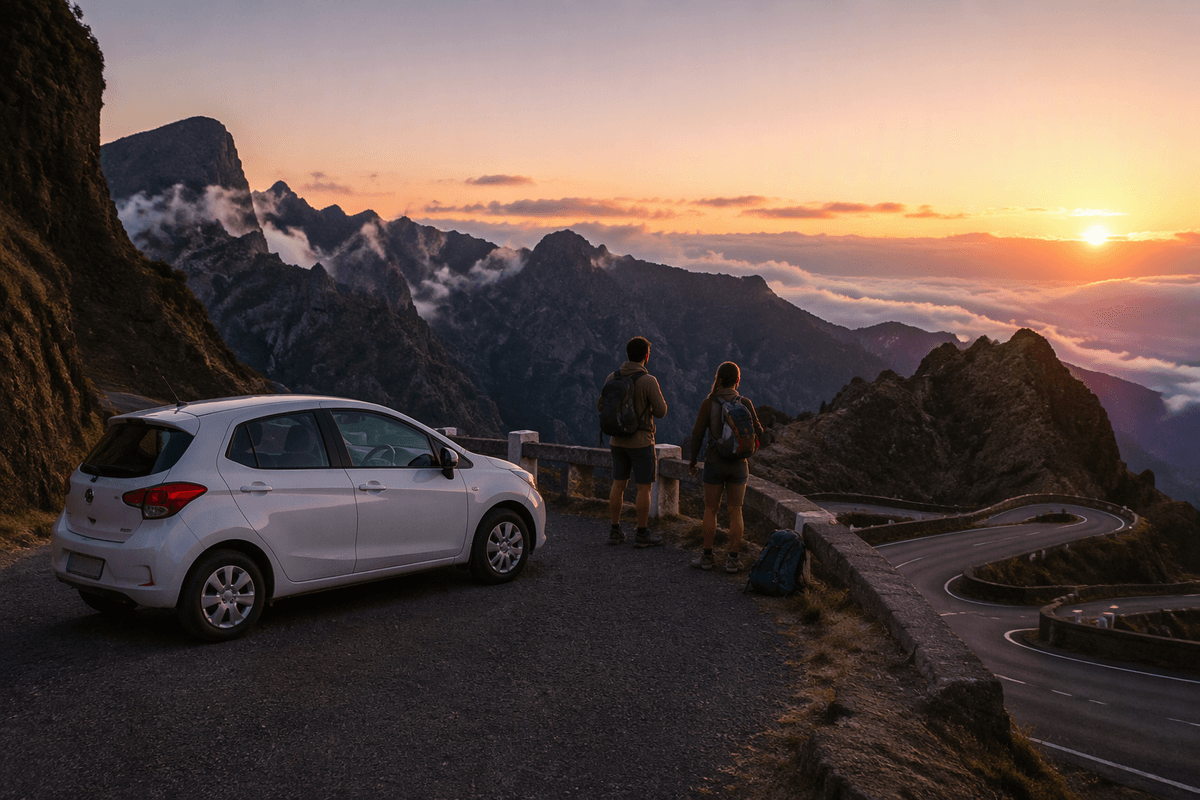
On our second night in Funchal, we tried to map a “simple” morning: Pico do Arieiro for sunrise, then down to a levada entrance, then lunch somewhere not on a tour route. On paper it fit. In reality, this is exactly the kind of day that quietly demands a car—because the value isn’t the distance, it’s the timing and the sequence.
A rental car is genuinely worth it if you’re planning two or more self-led hikes that start early (or finish somewhere different than they begin), especially in the mountains where weather windows are short and buses don’t line up neatly with trailhead logistics. It also pays off if you want to stack viewpoints and small villages in one loop (think “one-hour stops” that tours won’t give you), or if you’re the type that will change plans when fog rolls in and you need to drop altitude fast. The limitation is real: you’re buying flexibility with attention—steep gradients, tight pull-offs, and parking bottlenecks near popular spots can erase your time savings if you arrive late.
If that sounds like your trip, the most efficient pattern is a 2–3 day midweek car rental (not all 6 days), keeping Funchal days car-free so you’re not paying to hunt parking when you least need it.
When you can skip the car confidently
There was a moment we almost booked a car “just in case,” then looked at our actual six-day map: Funchal base, a couple of viewpoints, and a few levadas we were happy to do as guided shuttles. If your plan looks like that—one major activity per day, not a daisy-chain of stops—you can skip the car confidently and spend your effort on timing instead of driving.
You’re in the safe no-car zone if (1) most of your evenings are in Funchal, (2) you’re okay choosing hikes that have simple logistics (out-and-back, or ones with dependable tour transfers), and (3) you don’t care about being first at the parking lot at sunrise. Buses work best for “single destination” days, but they get awkward when you want to hop between a trailhead, a viewpoint, and a coastal town on the same afternoon—connections eat daylight and you can’t always count on a quick Plan B if clouds move in.
The practical pattern is to pre-book 2–3 day tours/shuttle hikes for your non-negotiables, then use Bolt/taxis to smooth the short gaps (hotel-to-cable-car, dinner across town, a viewpoint that’s annoying by bus). It’s not as improvisational as a car, but it’s calmer—and for a moderate-budget trip, it often keeps the “hidden costs” (parking, nerves, and wasted loops) from quietly piling up.
Cost breakdown: car vs tours, taxis, and buses
We started pricing it out one evening in Funchal and immediately hit the annoying part: the “cheap” option depends on how concentrated your days are. A small rental car can look reasonable per day, but Madeira adds little line items fast—paid parking near the center, a few tolls, fuel, and sometimes the premium you pay for an automatic. If you only need the car for two big mountain days, paying for it all six days is where the math turns on you (because you’re also paying in time hunting a spot when you could be walking to dinner).
Against that, day tours and shuttle-style levada hikes are blunt but predictable: one price, no parking, no white-knuckle descents in fog. The catch is you can accidentally “buy” a whole day even when you only needed transport—pickups, group pacing, and fixed stops can stretch a 4–5 hour hike into an 8-hour block. Taxis/Bolt sit in the middle: great for point-to-point convenience from Funchal, but they get expensive fast if you try to stitch together multiple remote viewpoints, and they’re not always a reliable solution for remote trailhead pickups.
For a 6-day Funchal base, the most cost-stable pattern is usually either (a) 2–3 guided/shuttle hike days + Bolt for city edges, or (b) a 2–3 day midweek car rental for your “stacked” days, then go car-free the rest—because that’s when your spending matches your actual need for flexibility.
Trade-offs beyond price: time, access, stress, safety

One morning we watched a perfect-looking sunrise window close while we were still waiting on a connection—an annoying reminder that “no car” often costs you hours, not dollars. Buses and tours are efficient when your day is one clean objective, but they punish anything layered: viewpoint + levada + coast becomes a timetable puzzle, and your Plan B in fog is whatever the next departure allows. A car flips that: you can drop altitude fast, chase clearer skies, and start hikes early, but your day can still get chewed up by slow mountain roads and arriving to a full roadside pull-off.
Access is the quiet divider. Trailheads with shuttle logistics are easy without wheels; less-famous levada starts and scattered miradouros are where you feel the gaps, especially if you want odd hours. Stress also changes shape: driving in Madeira isn’t dangerous by default, but steep gradients, narrow lanes, and low cloud can spike your attention in a way that makes a “relaxing” day feel like work. Tours reduce that load, but trading independence for group pacing can be its own friction if you’re trying to keep hikes moderate and still be back in Funchal for dinner.
Safety is mostly about conditions and fatigue. If either of you is already uneasy about steep roads, don’t plan on “getting used to it” on a sunrise start after a late night—pick tours for mountain days, then keep Bolt and walking for Funchal, where the margin for error is larger and the payoff for a car is smaller.
Decision checklist: the best option for your trip
We ended up treating the transport choice like a checklist, not a personality test, because Madeira rewards clarity. Start with your “non-negotiables”: if you want two+ self-led hikes with early starts, or you’re intent on stacking stops (sunrise + levada + coast) in one day, a 2–3 day rental usually fits better than trying to force buses to cooperate. If your plan is one main thing per day and you’re happy with shuttle logistics for the hikes, you’ll lose less time (and patience) staying car-free.
Then pressure-test your stress tolerance: if either of you is already worried about steep roads or fog, don’t spend your most weather-dependent days white-knuckling descents—book tours for the mountains and keep Bolt/taxis for the edges of Funchal. The one scenario that consistently “wins” is a split approach: no car in Funchal, a midweek rental for your flexibility days, and tours only for the trailheads that are awkward to reach or tricky to finish without a pickup.