You thought bonds would trade like stocks
It usually starts with a clean stock-market expectation: you pull up a CUSIP, see a “price,” click buy, and assume the market is the market. Then the first bond ticket feels oddly incomplete. You’re staring at a quote that looks tight, but you can’t tell how many bonds are actually available at that level, whether the platform is showing a dealer’s inventory or a broader market, or why the same maturity has multiple “best” prices depending on which screen you’re on.
That mismatch matters because bonds don’t trade on a single, centralized book the way most stocks do. For a self-directed investor or small advisor trying to control costs, the friction shows up immediately: minimum trade sizes, odd lot penalties, and a sense that the quote is more like an invitation than a guarantee. Once that expectation breaks, the platform choice stops being about a pretty yield display and starts being about what’s really behind the price.
First mismatch: your “price” isn’t the total cost
The first time it clicks is when the “price” looks fine but the confirmation screen doesn’t. With bonds, the number you anchor to might be a clean price, while your actual cash outlay is built from pieces that don’t show up until late: accrued interest since the last coupon date, any platform ticket charge, and—on many corporate and muni trades—a markup or markdown embedded in the quote. On a $25,000 trade, those add-ons can be the difference between “pretty close to par” and a result that quietly drags your yield.
It’s also why two platforms can both advertise “$0 commissions” and still land you in very different all-in economics. One might show you the yield to worst after costs and clearly break out accrued interest and estimated spread; another might only show a dollar price and leave the rest implicit. The practical constraint is timing: if you’re comparing bonds quickly, you can’t wait until the final ticket to discover you’re paying more than the screen suggested. You need the platform to make the all-in number hard to miss.
Second mismatch: the same bond varies by inventory

The next surprise is that even after you’ve learned to focus on all-in economics, the “same” bond still won’t behave like a single product. You can pull the identical CUSIP on two platforms and see meaningfully different yields, not because one is mispricing it, but because each screen is gated by available inventory. One broker might only be showing its own dealer position; another might be routing out to multiple counterparties; a third might show a curated list that disappears the moment you change size from 10 bonds to 25. The constraint is practical: if you need to place $50,000 today and the only displayed liquidity is a $5,000 odd lot, the quote is informational, not executable.
This is where “transparent pricing” stops being just a fee question and becomes an access question. Watch what happens when you toggle trade size, swap between “best price” and “depth,” or try to stage a sell on a corporate you already own. If the platform can’t show multiple dealers, recent trade prints, and estimated bid/ask ranges for the same CUSIP, you’re effectively negotiating in the dark. Inventory coverage is a feature, and it changes your outcome as much as the markup does.
Third mismatch: order tools change your outcomes
The shift from “what’s the price?” to “can I control the trade?” usually happens when the bond you want is there, but only at a size or level that doesn’t match your plan. In stocks, a limit order feels like a basic safety rail. In bonds, the platform might only let you accept a live dealer quote that expires in seconds, or it might let you enter a limit that just sits as a “request” until someone chooses to respond. That difference sounds subtle until you’re trying to buy $40,000 and the only displayed offer is $10,000, leaving you to either split the trade manually or overpay for the rest.
Order tools also change how mistakes show up. If the ticket defaults to “fill-or-kill” style quotes, you can churn through multiple dealers and still miss the market during a fast rate move. If the platform supports “all-or-none,” partial fills, or lets you stage multiple sizes side-by-side, you can protect the yield you modeled without constantly reworking the math. The constraint is time and attention: when the quote clock is running, the platform’s routing, size controls, and preview of all-in yield are what decide whether you get a clean execution or a series of small, costly compromises.
When quotes look good but fills disappoint
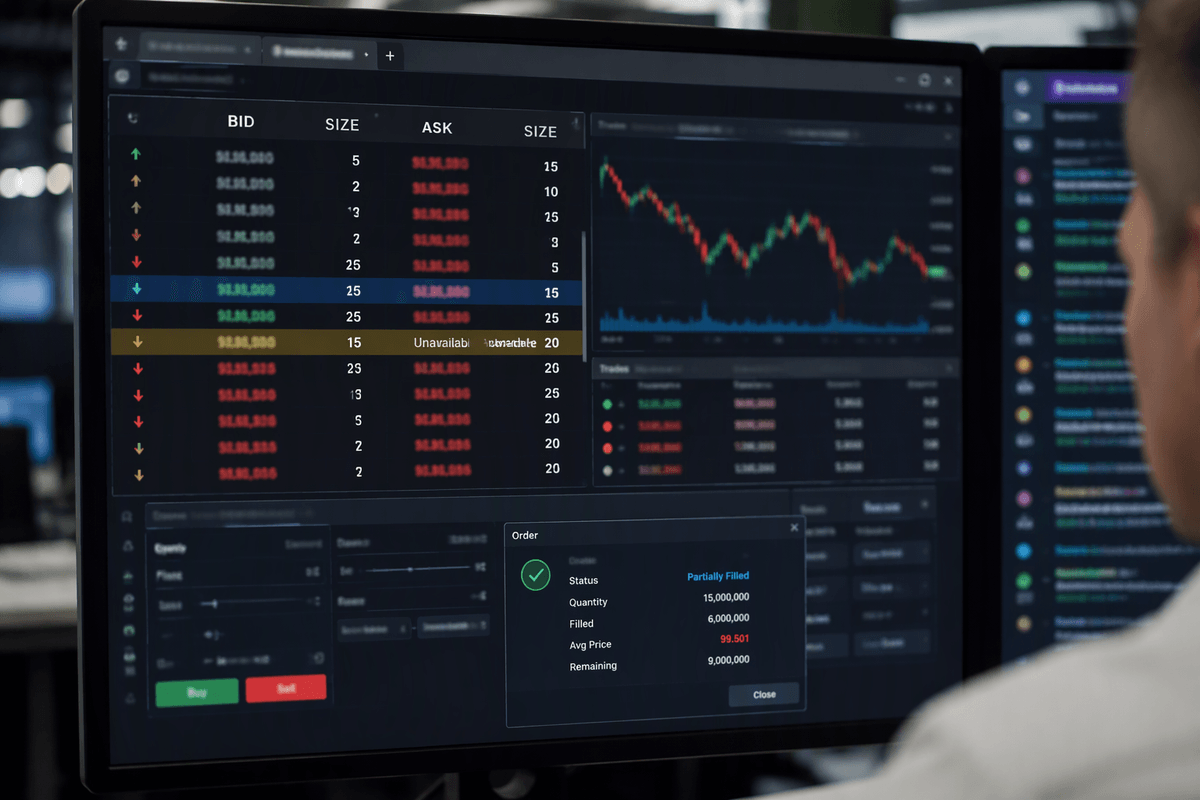
The first time a fill surprises you, it’s rarely dramatic. The quote looked tight, the yield was inside your range, and then the execution comes back a notch worse—or only a slice fills and the rest re-quotes higher. In bonds, that gap is often just the platform showing “indicative” levels until a dealer actually commits size. If rates are moving, the clock on a live quote matters more than the spread you screenshotted, because you’re effectively paying for certainty in real time.
This is where execution quality turns into a feature you can feel. Some platforms refresh quotes aggressively but won’t hold them long enough for a thoughtful review of accrued interest and all-in yield; others are slower but more stable. Minimum denominations and odd-lot behavior add another constraint: a great price for 5 bonds can evaporate at 25, and partial fills can leave you with cash drag or an unplanned second trade at worse levels. The practical test is simple: watch how often “best” becomes “no longer available,” and how clearly the platform explains what changed—price, size, or both.
A shortlist scorecard you can actually run
After a couple of those “looked fine, filled worse” trades, the platform choice gets easier if you force it into a scorecard you can run in ten minutes, under your usual constraints (trade size, time of day, urgency). Pull the same three CUSIPs you actually trade—one Treasury, one investment‑grade corporate, one muni—then test two sizes (an odd lot like $5,000–$10,000 and your real ticket like $25,000–$100,000). If the “best” level changes sharply with size, mark inventory depth as weak. If you can’t see accrued interest and an all‑in yield before committing, mark transparency as weak.
Then grade the execution controls with one practical drill: can you stage a limit, see whether it’s a firm quote versus a request, and preview what happens if only part fills? If the only workflow is rapid-fire quote acceptance with a short clock, you’re paying with attention risk. Finally, check the post-trade reality: does the confirm clearly separate clean price, accrued, and any ticket charges, and does the platform give you enough context (recent prints or bid/ask range) to judge whether the fill was fair? Keep the shortlist to whoever passes all four: all‑in clarity, depth by size, usable order controls, and honest confirmations.
Choose based on your next trade, not hype
At this point the marketing claims stop helping, because your constraint is the next ticket you actually have to place. If you’re buying $10,000 of a Treasury in a calm market, the “best” platform is often the one that shows the all-in cash outlay instantly and doesn’t make you click through three screens to see accrued interest. If you’re selling a corporate you already own, the winner is usually the one that shows multiple bids, updates with size, and doesn’t punish you for being an odd lot. The same broker can be great for one and expensive for the other.
So the decision gets narrower: pick the platform that is strongest at your most common, most painful trade. If the stress comes from speed, prioritize firm quotes with a clear clock and a predictable re-quote process. If the stress comes from cost control, prioritize pre-trade yield after costs, visible depth at your size, and a ticket that makes partial-fill math obvious. The “right” choice should feel less like a brand bet and more like removing one specific surprise you’re tired of paying for.